

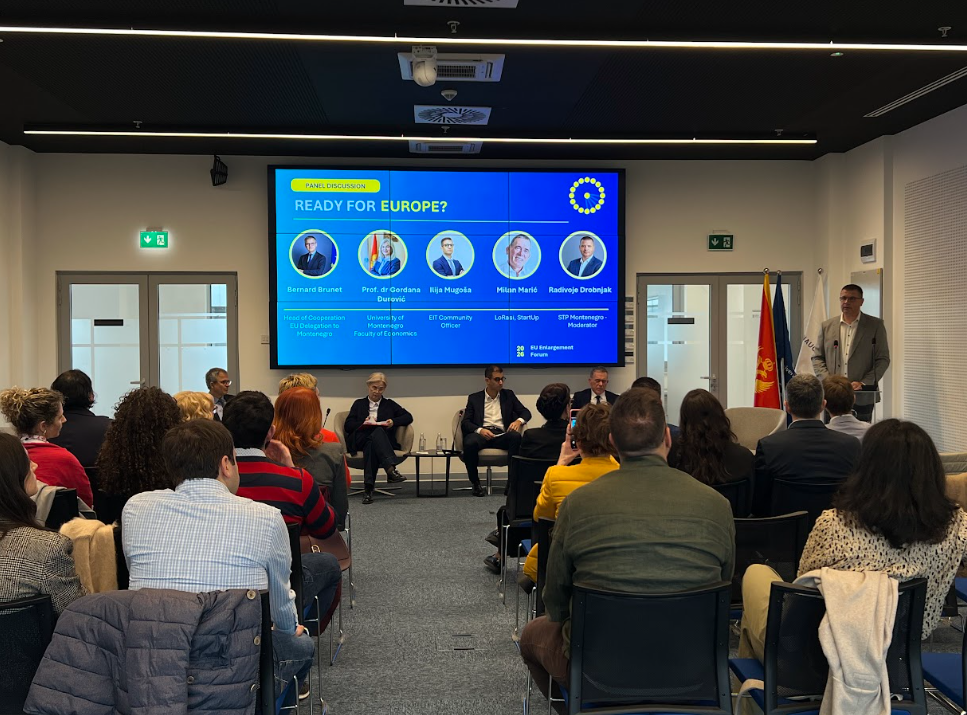
The competitiveness of Montenegrin innovative companies, their readiness to enter the European Single Market, and the opportunities arising from Montenegro’s EU accession process were at the heart of the panel discussion “READY FOR EUROPE? – Montenegro’s Startups and SMEs on the Road to EU Membership”, held on 19 November at the Science and Technology Park of Montenegro.
The event was organised as an official satellite event of the EU Enlargement Forum 2026, organised by the European Commission. It brought together representatives of European institutions, academia, the innovation ecosystem, and domestic innovative companies.
The central question of the discussion was how prepared Montenegrin startups and small and medium-sized enterprises are to compete in the European market, and what steps are needed to ensure that the European integration process delivers tangible benefits for the country’s economy.
Opening the event, Valentina Radulović, MSc, Executive Director of the Science and Technology Park of Montenegro, emphasised that domestic innovative companies are already demonstrating Montenegro’s knowledge, creativity, and potential to develop competitive technological solutions capable of meeting the demands of international markets.
She stressed that successful entry into the European market requires continuous strengthening of the innovation ecosystem, access to knowledge and financing, the development of international partnerships, and a more supportive environment for innovative business growth. In this process, the Science and Technology Park of Montenegro remains committed to supporting companies in developing their business potential and connecting with the European innovation ecosystem.
Preparation for the European market does not begin on the day of EU accession – opportunities for cooperation, innovation, and internationalisation are already available today. This was one of the key messages of the event.
The panel discussion addressed major challenges faced by Montenegrin entrepreneurs, ranging from compliance with European standards and digital business transformation to access to finance, international networking, and integration into European value chains.
Bernard Brunet, Head of Cooperation at the European Union Delegation to Montenegro, emphasised that the European integration process is already creating significant opportunities for Montenegro’s economy. However, taking advantage of these opportunities requires companies to continuously prepare for participation in the European Single Market.
He highlighted the importance of maintaining dedicated efforts to improve the business environment, strengthen competitiveness, and implement European standards, encouraging Montenegrin companies to actively seize the opportunities available to them even before formal EU membership. His message further underlined that European integration is not merely about regulatory compliance, but also represents an opportunity for economic modernisation, business growth, and stronger connections with the European market.
Addressing Montenegro’s economic readiness for EU membership, Professor Gordana Đurović, PhD, from the Faculty of Economics at the University of Montenegro, highlighted the need for systematic preparation of small and medium-sized enterprises for the European Single Market, including compliance with EU standards, digitalisation, workforce development, and improved access to diverse financing instruments.
She particularly emphasised the importance of strengthening cooperation between universities and businesses, with a more active role for the Science and Technology Park and its Technology Transfer Office in research commercialisation and the development of innovative companies. She also identified accelerated business internationalisation, integration into European value chains, and timely preparation of institutions and companies to benefit from future EU funding opportunities as key priorities.
Ilija Mugoša, EIT Community Officer for Montenegro, discussed the opportunities that the European innovation ecosystem already offers to Montenegrin startups and innovative SMEs. He highlighted the importance of connecting with the European Institute of Innovation and Technology (EIT) network, which facilitates access to knowledge, research capacities, expertise, and international partnerships.
He particularly stressed the importance of more active participation by Montenegrin companies in European innovation networks and programmes, noting that cooperation with European partners can significantly contribute to developing more competitive products, improving business models, and entering new markets.
The perspective of Montenegro’s innovative business community was presented by Milan Marić, founder of the startup LoRasi and a member of the Science and Technology Park’s business community. Drawing on his company’s development experience, he discussed the practical challenges faced by Montenegrin startups, particularly in internationalisation, building business partnerships, and entering competitive international markets.
His experience illustrates the potential of technological solutions developed in Montenegro to find applications internationally, while also highlighting the importance of continuous support for market access, business development, and connections with relevant partners.
The discussion was moderated by Radivoje Drobnjak, Head of the Sector for Innovative Programmes and Projects at the Science and Technology Park of Montenegro, who guided the exchange towards identifying practical challenges and priorities for improving the readiness of domestic startups and SMEs for the European market.
European Integration as an Opportunity to Build a More Competitive Economy
Drawing on the different perspectives of the panelists, the discussion identified several key priorities: improving companies’ readiness to operate in the European Single Market, strengthening cooperation between research and industry, developing more accessible financing instruments, intensifying international networking, and enhancing the capacity to participate in European programmes and access EU funding.
The shared message of the discussion was that successful European integration involves much more than meeting formal accession criteria and aligning legislation. It also requires building an economy capable of competing effectively in the European market.
For Montenegrin startups and SMEs, this means that preparations should not be postponed until the country joins the European Union. Developing innovative products and services, investing in knowledge, adopting international standards, establishing partnerships, and joining European business and innovation networks are steps that companies can and should take today.
The Science and Technology Park of Montenegro will continue to strengthen the competitiveness of domestic innovative companies and facilitate their integration into the European market through its support programmes, services, infrastructure, and international partnerships.
The objective is to ensure that Montenegrin companies approach future EU membership not simply as a new market opportunity, but as an opportunity for which they have prepared in advance – with develope.

Science and Technology Park Montenegro
Science and Technology Park Montenegro was established with the aim of providing support and strengthening the potential of economic growth and development of Montenegro
Strategy partner

© 2024 ntpark.me / All rights reserved


