

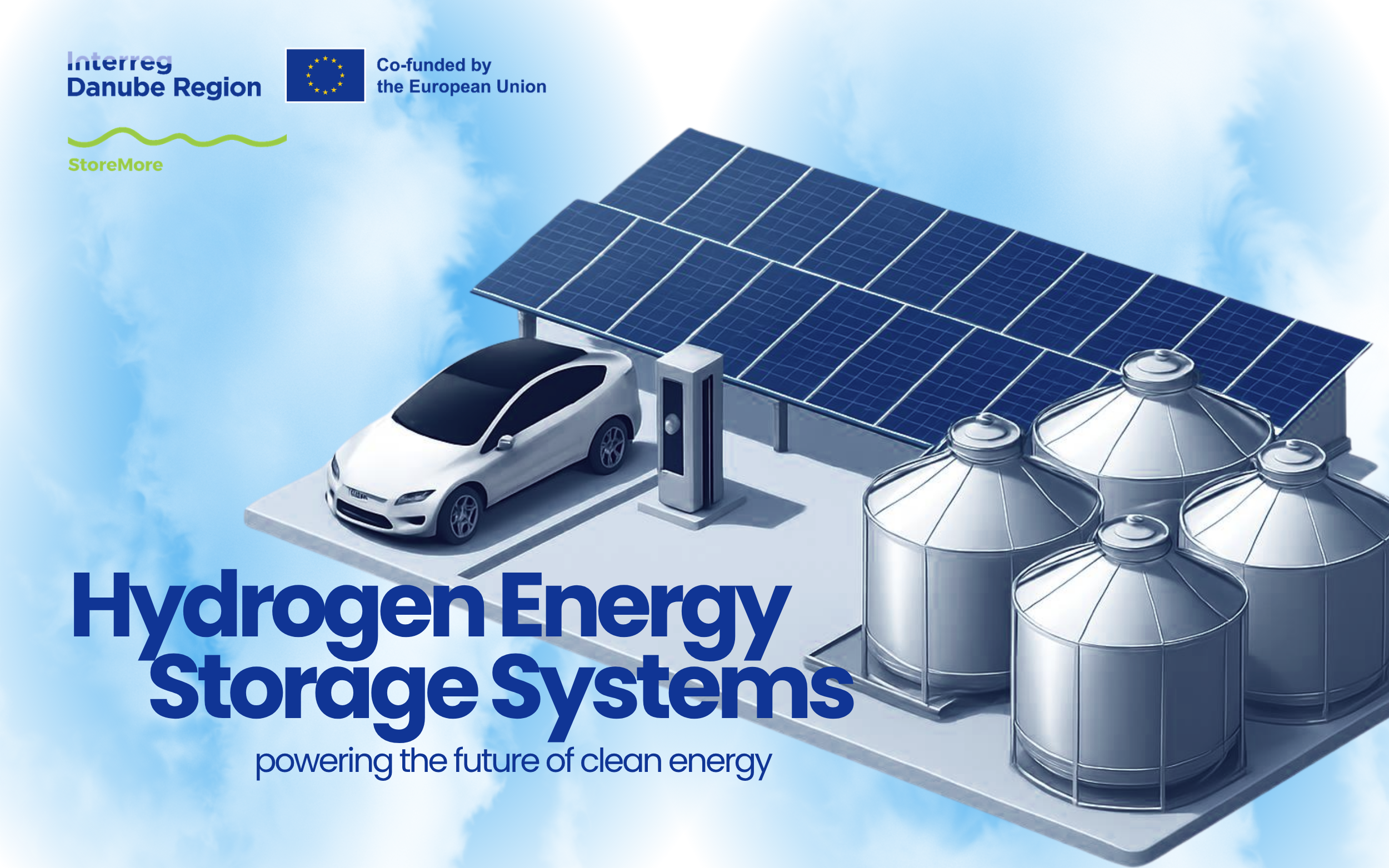
With the accelerated development of renewable energy sources, storage is no longer only a matter of short time intervals, but there is an increasingly pronounced need for solutions that enable the management of energy surpluses over days, weeks, and even entire seasons, as discussed in the project newsletter. Within the StoreMore project, one of the most strategically important and widely discussed directions in energy transition was presented—the Hydrogen Energy Storage System (H2ES).
Unlike battery or mechanical systems, hydrogen enables energy storage in chemical form. The process begins with electrolysis, using electricity to split water into hydrogen and oxygen. The resulting hydrogen can then be stored, transported, and used as needed—for electricity generation, as an industrial feedstock, or as a fuel in transport and heating applications.
Why is hydrogen important?
Hydrogen offers unique advantages that distinguish it from other energy storage technologies:
Long-term energy storage – enabling seasonal balancing of energy systems.
Sector coupling – integrating energy, industry, transport, and heating.
Industrial decarbonization – crucial for sectors that are difficult to electrify (steel, chemicals, refineries).
Energy security – reducing dependence on imported fossil fuels.
Where is it applied?
Hydrogen systems have a wide range of applications:
- Storing excess energy from solar and wind power plants.
- Industrial production and the replacement of fossil fuels.
- Backup and emergency energy systems.
- Heavy transport (trucks, buses, rail transport).
- Development of integrated, hybrid energy solutions.
Challenges and limitations
Despite its significant potential, the development of hydrogen infrastructure faces a number of challenges:
- High investment costs.
- Complexity of storage and transport.
- Lower overall energy efficiency
- Technical and safety requirements
- The need for a clear market and regulatory framework
Hydrogen is not a universal solution for all energy challenges, but it represents a key component of a future sustainable energy system. Its greatest value lies in long-term energy storage, sector coupling, and supporting industrial decarbonization.
For more details shared on this topic, you can listen to the podcast produced within the project.
For the Science and Technology Park of Montenegro, as one of 11 partners in the StoreMore project from 10 countries of the Danube region, this represents an opportunity to be at the center of innovations that will shape the energy future of the region. The StoreMore project is co-financed by the European Union through the Interreg Danube Programme.
For more news and updates on H2ES and other results of the StoreMore project, please visit our social media channels:
Website: https://interreg-danube.eu/projects/storemore
LinkedIn: https://www.linkedin.com/company/storemoreproject/


Science and Technology Park Montenegro
Science and Technology Park Montenegro was established with the aim of providing support and strengthening the potential of economic growth and development of Montenegro
Strategy partner

© 2024 ntpark.me / All rights reserved